
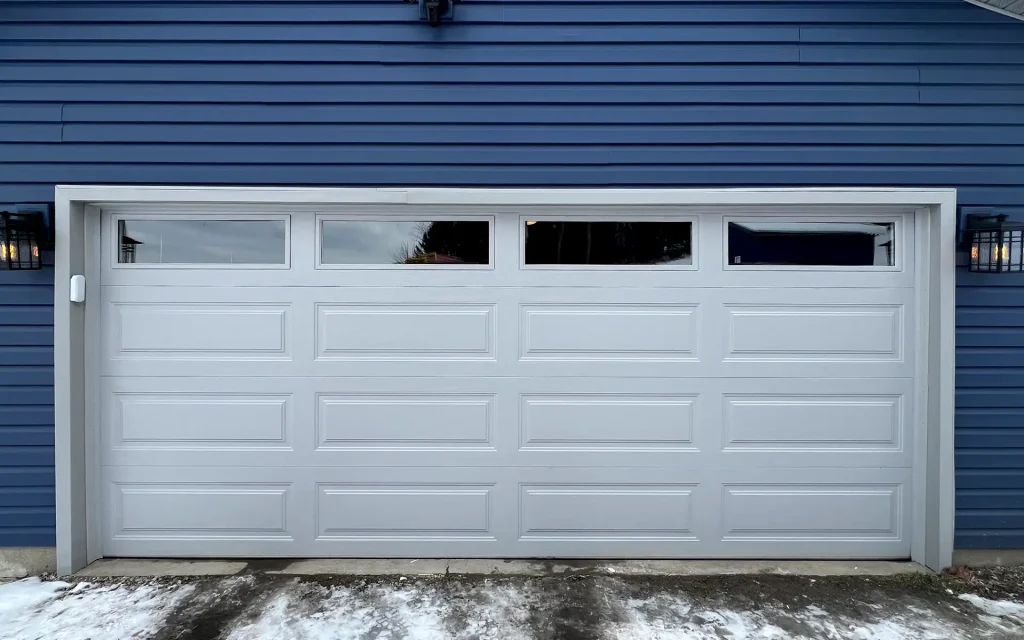
You press the remote, watch the door reach the floor, and then see it rise again before you can leave. J Andrews Doors helps homeowners resolve this exact kind of failure across Northeastern Ohio, Western Pennsylvania, and the Northern Panhandle of West Virginia.
A reversing door is not being stubborn. The opener may be reacting to a blocked safety beam, an incorrect travel setting, resistance in the door, or a fault that needs professional diagnosis. The reversal point helps narrow the possibilities, but not every repair is safe to attempt yourself.
The safest starting point is observation. Keep everyone away from the opening, operate the door only while it remains in full view, and do not repeatedly cycle it while hoping the problem disappears. Genie’s current garage door opener manual says to keep a moving door in sight, keep people and objects clear, and never operate a door that jams or has a broken spring.
Start With When the Door Reverses
Watch one normal closing cycle from a safe position outside the door’s travel path. Does the door reverse before touching the floor, immediately after touching it, or at the same spot partway down?
A door that reverses before the floor points first toward the photo-eye system, an obstruction, binding, or opener settings. A door that touches the floor and then rises often points toward the down-travel limit or contact-reversal setting. Genie identifies sensor obstruction or misalignment, incorrect limits, binding, and force control as checks for a door that starts down and goes back up; LiftMaster also separates the hit-the-floor-and-reverse symptom in its support library.
Do not stand under a partly open door to inspect it. Both Genie’s manual and the U.S. Consumer Product Safety Commission’s garage door opener safety guidance warn about the danger created by a poorly balanced door and direct homeowners to professional service when a door binds, sticks, or is not balanced.
Cause 1: Something Is Blocking the Door or Sensor Beam
Start with what you can see without touching the moving system. A trash can, broom, bicycle tire, garden tool, accumulated debris, or another object may be in the door’s path or crossing the invisible beam between the two photo eyes near the floor.
Remove loose objects while the door is fully open and stationary. Then look across the threshold from outside the opening and confirm that nothing projects into the path. Genie’s troubleshooting guidance identifies a physical Safe-T-Beam obstruction as a reason a closing door may stop and return upward.
Also look at both sensor lenses for obvious dirt or debris. Genie includes cleaning sensor lenses and checking the beam system in its regular maintenance schedule. If a gentle cleaning allowed by your exact owner’s manual restores normal indicator lights, try one normal close while the doorway stays clear and in view.
Cause 2: The Photo Eyes Are Misaligned
The two low-mounted photo eyes must face one another so the receiving sensor can detect the beam. A bumped storage bin or minor impact can leave a sensor visibly turned even when nothing blocks the opening.
Genie’s manual says a blinking transmitter light can indicate a misaligned or obstructed beam, while its diagnostic chart distinguishes alignment, wiring, interference, and defective-sensor conditions. Those light patterns are specific to the opener described in that manual, so do not assume your LiftMaster, Genie, or other opener uses the same colors or blink counts.
You may compare each sensor’s position and lights with the diagram and diagnostic section in the owner’s manual for your exact model. If the correction would require rewiring, replacing a bracket, removing an opener cover, or guessing at terminals, leave it for service rather than turning a visual check into electrical work.
Cause 3: Sunlight or Nearby Sensors Are Interfering
A door that acts up only at a certain time of day may be giving you a useful clue. Genie states that direct sunlight can interfere with the receiving Safe-T-Beam sensor and make the opener detect an obstruction; its troubleshooting chart also recognizes interference as a separate sensor fault.
Notice whether the failure follows bright sun or occurs when a neighboring door is operating, but do not improvise shades, swap sensor types, or relocate wiring. Genie explicitly says to use only the sensors intended for the opener, and model-specific placement matters. A professional can confirm interference and correct the installation without defeating the entrapment-protection system.
Cause 4: The Down-Travel Limit Is Set Too Far
The down-travel limit tells the opener how far the door should move before reaching its closed position. Genie defines travel limits as programmable settings for how far the door travels up or down.
If the opener drives the door too far against the floor, the resistance can trigger reversal. Genie says the bottom seal should compress enough to seal across the opening but not so much that the door bends or buckles. Its contact-reverse section identifies an improperly set down limit as a possible reason a door does not respond correctly during the reversal test.
The timing is the giveaway: the bottom section reaches the floor, presses down, and the opener sends the door back up. An uneven floor, a damaged section, or a deteriorated seal can complicate what looks like a simple setting issue, so a limit adjustment should not be used to force a distorted door into place.
Adjustment sequences differ among opener models. Use only the owner’s manual for the exact model, and arrange service if you cannot identify the unit or if the door does not sit squarely at the floor. J Andrews Doors can diagnose opener limits as part of garage door repair and maintenance without turning knobs or programming buttons blindly.
Cause 5: The Door Is Binding or Mechanically Unbalanced
An opener is designed to move a properly operating door, not overpower damaged hardware. Genie warns never to increase force to compensate for a binding track, broken spring, or unbalanced door, and its troubleshooting section names binding as a cause of a door that starts down and reverses.
From a safe distance, look for a door that hangs crooked, rollers that appear outside the track, loose sections, frayed cable, a visible gap in a spring, or one side moving ahead of the other. Do not touch the springs, cables, drums, bottom brackets, or tracks to “see if they are loose.” Genie states that springs and connected hardware are under high tension and that their repair or adjustment belongs to a trained door-system technician.
If you see a broken spring, damaged or slack cable, drum problem, crooked door, unexpectedly heavy door, or an unbalanced door: No. Stop using the door.
Do not pull the emergency release on an already failing, open, crooked, or suspect door. Genie warns that weak or broken springs can increase the closing rate when the release is used and says an improperly balanced door should not be operated automatically or manually.
This is the point to schedule professional residential garage door service.
Cause 6: Force or Reversal Settings Need Diagnosis
The opener monitors the effort needed to move the door. Genie defines force control as the power needed to open or close a particular door and says its modern units record that setting during a complete operating cycle.
More force is not a shortcut around resistance. Genie’s manual says factory force settings normally should not need adjustment and specifically warns against changing force to compensate for damage, a binding door, or a broken spring. An incorrect setting can also affect whether the door passes the required contact-reversal test.
Because the safe result depends on the door’s mechanical condition, travel limits, and the exact opener, start with diagnosis rather than a generic force-adjustment tutorial. J Andrews Doors can inspect the door and opener together, make the appropriate model-specific correction, and retest the safety functions afterward.
Cause 7: The Opener Has a Component or Wiring Fault
When the doorway is clear and the sensors look normal, the fault may be inside the opener system. Genie’s diagnostic information includes damaged sensor wiring, defective sensors, program errors, and component errors.
Do not remove the opener cover or attempt logic-board, high-voltage, or internal wiring work. Genie warns that electrical power must be turned off before a cover is removed and directs users to trained service for component failures. A service technician can read the model-specific indicators and distinguish an opener problem from a door problem.
Safe Checks You Can Make Before Scheduling Service
First, keep the door fully in view and clear the opening while it is stationary. Note whether the door reverses before contact, at contact with the floor, or at one repeatable point during travel.
Next, visually inspect the threshold and photo-eye path. Remove loose obstructions, clean only as the exact manual permits, and compare the sensor lights with that model’s documentation. Do not adjust wiring, opener electronics, or tensioned hardware.
If the door otherwise appears straight, stable, and undamaged, you can check the photo-eye response without touching either sensor. Open the door fully, place a light, nonvaluable object across the beam without letting it touch the sensors, stand outside the travel path with the opening in view, and use one normal wall-control press. Depending on the model, the door should refuse to close or begin closing and reverse; if it closes through the blocked beam, stop automatic use and follow the exact manual or schedule service.
The CPSC also recommends a monthly contact-reversal test with a standard two-by-four laid flat at the center of the door’s path. When a visually sound system contacts the board, it should reverse; if it does not, disengage automatic use until the opener has been adjusted according to its manual, repaired, or replaced. Never increase force just to make a test pass.
When to Escalate the Problem
Stop troubleshooting and call for service if the door is crooked, heavy, binding, jammed, dropping, or showing damaged springs, cables, drums, rollers, or sections. Use the same hard stop for a failed photo-eye or contact-reversal test; the CPSC treats reversal as essential entrapment protection.
Repeated reversal after the opening is clear also warrants diagnosis. The cause may require model-specific limit programming, force evaluation, sensor replacement, wiring repair, or mechanical door work. You can review J Andrews Doors’ frequently asked questions, then request an appointment instead of continuing to cycle the door.
Frequently Asked Questions
Why Does My Garage Door Go Down and Then Back Up?
The opener may be responding to a blocked or misaligned photo eye, an incorrect down-travel limit, binding in the door, interference, or a fault in the sensor or opener. Genie lists those conditions in its current manual, but the reversal point and model-specific diagnostic lights are needed to narrow the cause.
Why Does the Door Touch the Floor Before Reopening?
That pattern often directs attention to the down-travel limit and contact-reversal setup. Genie says the closed-position seal should compress enough to seal without making the door bend or buckle, and it identifies an improperly set down limit as a possible reversal-test problem.
Can Sunlight Make a Garage Door Reverse?
Yes, on systems affected by direct light at the receiving photo eye. Genie states that direct sunlight can interfere with its receiving Safe-T-Beam sensor and make the opener detect an obstruction. A professional can correct placement while maintaining proper alignment and compatible sensors.
Is It Safe to Fix This Myself?
You can clear loose obstructions, observe the reversal point, and consult the exact owner’s manual if the door is straight, stable, and visibly undamaged. For springs, cables, drums, or a crooked, heavy, or unbalanced door: No. Stop using the door.
Do not perform tensioned-hardware, internal electrical, or logic-board work.
How Much Does This Repair Cost?
There is no responsible single price based only on the symptom. Diagnosis, parts, opener model, door condition, and labor all affect the final cost. Ask J Andrews Doors for a written estimate after diagnosis rather than relying on an invented online range.
Should I Replace the Opener or Repair It?
Repair may make sense when the door is mechanically sound, compatible parts remain available, and the safety system can be restored. Replacement deserves consideration when parts are unavailable or the opener cannot provide dependable reversal protection; the CPSC advises repairing or replacing nonreversing openers and says openers made or imported for U.S. sale after January 1, 1991, must have reversing systems.
How Often Should I Test the Reversal System?
The CPSC and Genie both call for monthly testing. Use the exact owner’s manual, test only a visually sound door, keep the opening clear, and stop automatic use if either the photo-eye response or contact-reversal test fails.
Get a Clear Diagnosis Without the Guesswork
A door that closes and immediately reopens is giving you a warning, not inviting more force or repeated attempts. J Andrews Doors can inspect the complete system, explain what failed, and recommend repair or replacement without a pushy sales approach.
For garage door and opener service across Northeastern Ohio, Western Pennsylvania, and the Northern Panhandle of West Virginia, contact J Andrews Doors or call (330) 870-3667. Share the opener model, light pattern, and reversal point when you call; you will get a straightforward next step and can ask for a written estimate before work begins. No coupons, no gimmicks, our best price is our first price.